The Gruuthuse Manuscript

The Gruuthuse Manuscript (see online version) is a unique codex that still carries many secrets. It consists of prayers, poems and a remarkable collection of nearly 150 songs. Many of the songs are profane songs, mostly about love, complete with musical notation. This songbook is the largest and oldest collection of this genre from the medieval Low Countries.

The Gruuthuse manuscript is on exhibition until 23 June 2013

The Gruuthuse Manuscript is on display until 23 June 2013

In some of the songs, the city of Bruges is mentioned, and several of the writers are also associated with Bruges. But even though some names can be found in acrostics in the songs (e.g. Jan van Hulst), many questions about the manuscript remain unanswered. It is still unknown who ordered to write the manuscript, and for what reasons he did so. Furthermore, it is unclear who compiled the manuscript or who wrote the texts.

Visiting Bruges this Spring? This manuscript is on display until 23 June 2013 in the Gruuthuse Museum!

Back to: Jan van Hulst

Jan van Hulst

Jan van Hulst was a writer from Bruges who wrote some texts that ended up in both the Gruuthuse manuscript and in the Geraardsbergen manuscript. In the Gruuthuse manuscript, we find his name in an acrostic in two prayers and a poem, but there are some other texts that may be attributed to him as well. And he may have been the founder of the first chamber of rhetoric in Bruges.

Jan is frequently mentioned in archival documents from Bruges. He was, for example, commissioned to organise a play at Philip the Bold’s visit to the city of Bruges in 1393. And he is known to have organized polyphonic performances in churches.

The text in the Geraardsbergen manuscript is a letter to his friend, the priest and singer Perceval vanden Nocquerstocque. It was a rhymed letter about the loss of loyalty among friends.

Back to: People connected with the Geraardsbergen Manuscript

Perceval vanden Nocquerstocque

One of the most striking names in the Geraardsbergen manuscript is the name of Perceval vanden Nocquerstocque, member of a patrician family. Perceval was a priest in Geraardsbergen and was befriended with Jan van Hulst, who wrote him a rhymed letter about the loss of loyalty among friends. Jan and Perceval probably met through their shared interest in polyphonic music. Jan organized polyphonic performances in churches in Bruges while Perceval had a second career as a singer in polyphonic choirs.

In 1417 Perceval, probably in his late fourties, is mentioned as one of the singers in the Papal Chapel during the Council of Konstanz. As a member of the household of Pope Martinus V, he travelled to Switzerland after the Council had ended. In 1418 the pope resided in Geneva, but had to flee to the mountains when the city was afflicted by the plague. The pope survived, but Perceval was never heard of again.

For more information: see Further reading (Herman Brinkman’s article)

Back to: People connected with the Geraardsbergen Manuscript

Further reading: Geraardsbergen Manuscript

For more information on the Geraardsbergen Manuscript, you can consult the following publications:

Herman Brinkman, ‘Weerzien met Geraardsbergen’. In: Literatuur 21 (2004), pp. 11-13.

Theo Coun, ‘Codicologie of archeologisch graafwerk in middeleeuwse boeken’. In: Ria Jansen-Sieben, Jozef Janssens en Frank Willaert (eds.), Medioneerlandistiek. Een inleiding tot de Middelnederlandse letterkunde. Hilversum: Verloren, 2000. pp. 71-84. Middeleeuwse studies en bronnen, 69.

Marie-José Govers et al. (ed.), Het Geraardsbergse handschrift. Hs. Brussel, Koninklijke bibliotheek Albert I, 837-845. Hilversum: Verloren, 1994. Middeleeuwse Verzamelhandschriften uit de Nederlanden, 1. (electronic version of this edition, by Peter Boot and Herman Brinkman).

Marie-José Govers, ‘Van Ptolemaeus tot Joris. Een verkenning van een reeks bijschriften in het Geraardsbergse handschrift.’ In: G. Sonnemans, Middeleeuwse verzamelhandschriften uit de Nederlanden : congres Nijmegen, 14 oktober 1994. Hilversum: Verloren, 1996. pp. 125-143. Middeleeuwse studies en bronnen, 51.

Hans Kienhorst, ‘Hoe moet zo ‘n boek genoemd worden? Een vernieuwde kijk op Middelnederlandse verzamelhandschriften als codicologisch object’. In: Revue Belge de philologie et d’histoire 83 (2005), pp. 785-817 (for the Geraardsbergen manuscript, see pp. 790-792).

Robrecht Lievens, ‘Het Geraardsbergse handschrift.’ In: Leuvense bijdragen 85 (1996), pp. 147-161

Joris Reynaert, ‘De verborgen zijde van de middeleeuwse kopiist. Over de functie en de samenstelling van het Geraardsbergse handschrift’. In: Queeste 6 (1999), pp. 41-52.

Hubert Slings, ‘De Negen Besten ontcijferd. Getallensymboliek in het Geraardsbergse afschrift van Van den Negen Besten’. In: Queeste 3 (1996), pp. 25-42.

Gerard Sonnemans, ‘What’s in an name? Het belang van opschriften in verzamelhandschriften.’ In: G. Sonnemans, Middeleeuwse verzamelhandschriften uit de Nederlanden : congres Nijmegen, 14 oktober 1994. Hilversum: Verloren, 1996. pp. 61-78. Middeleeuwse studies en bronnen, 51.

Gerard Sonnemans, ‘Profiel van een Geraardsbergs compilator.’ In: G. Sonnemans, Middeleeuwse verzamelhandschriften uit de Nederlanden : congres Nijmegen, 14 oktober 1994. Hilversum: Verloren, 1996. pp. 110-124. Middeleeuwse studies en bronnen, 51.


Geraardsbergen, a Flemish town

In the 1060s, Geraardsbergen (Grammont) was founded as a strategic stronghold on the eastern border of the county of Flanders. With the economic attractive center at the western part of his county (with cities such as Ghent and Bruges), it was important for the count to attract people to the financially backwards eastern part of his reign. A way to do so was to promise the people in – or willing to move to – the East relative independence by assigning cities such as Geraardsbergen municipal laws. This strategy worked: the cities and their importance grew, as becomes clear (for example) from references to Geraardsbergen as a centre of (cloth) trade and production in the twelfth century.

The story of Geraardsbergen is certainly not all good news, as it has been a place of troubles several times. In the 1430s, for example, it was one of the centers of a peoples’ revolt against financial arrangements of the authorities. A century later, once again the people of Geraardsbergen revolted against the city rulers, this because the latter (in the opinion of the former) had chosen sides with the central authorities in a tax dispute.

Nowadays, the city of Geraardsbergen is known for a completely different kind of battle. Each Spring, thousands of cycling pro’s and tourists travel to Flanders to participate in the annual Tour of Flanders. The ‘high mass’ of the early cycling season is one of the oldest and most renown races on the cycling calendar. Perhaps the single most famous and certainly one of the most feared hills on the Northern side of the Alps is situated in Geraardsbergen: the Muur van Geraardsbergen (‘Wall of Geraardsbergen’), a steep climb onto the city’s ramparts.

Go to: Geraardsbergen manuscript

A Pilgrim as a Tourist

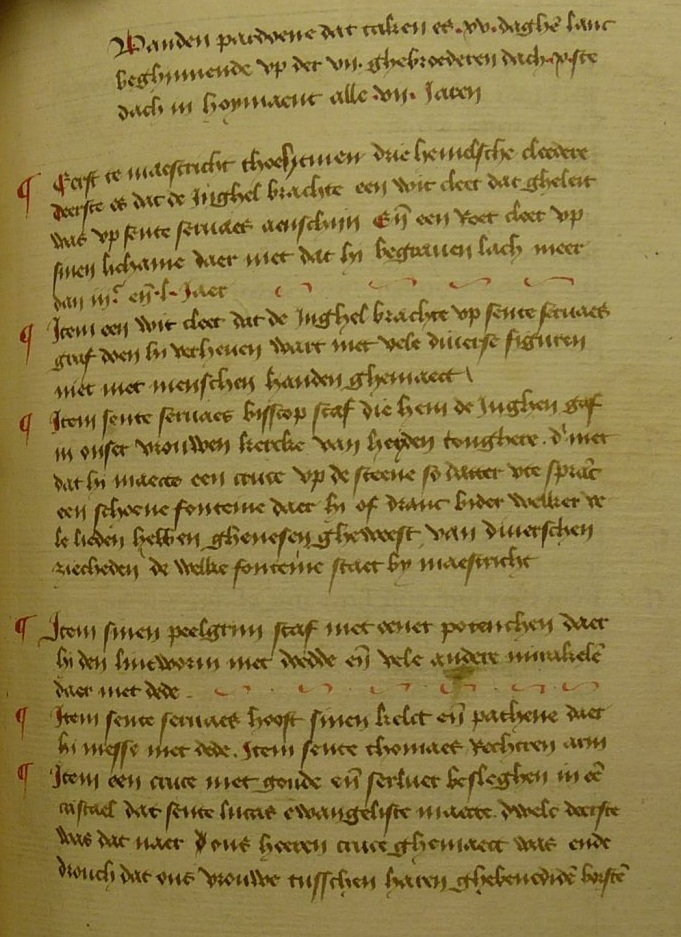
Brussels - KB - 837-45, fol. 133r: The ending of Text 69. The last two lines stand a little apart (by courtesy of the KBR Brussels)

Brussels – KB – 837-45, fol. 133r: The beginning of Text 69 (by courtesy of the KBR Brussels)

Geraardsbergen Manuscript, text 69 (fols. 133r-134r)

During the middle ages the main reason for going on a pilgrimage was that is was a positive element in bringing you salvation. There were places where you could always go (the most famous ones being Rome and Santiago de Compostella) but many other places had special religious festivities for a saint or a sanctuary too. Examples of this may be found in Maastricht and Aachen (Aix-la-Chapelle). In both places there was a special religious festival every seven years during which some relics were exhibited for the pilgrims that were normally kept behind closed doors. Visiting these relics was seen as an especially good deed. In both Aachen and Maastricht, the years in which these special pilgrimages took place were the same, and in those years there was also a special religious ‘exhibition’ in the monastery of Cornelimünster, near Aachen. So when you went in the correct year to this region you could deserve many indulgences in a day or two (up to 800 years less in purgatory!). And as a bonus you could see some very interesting relics that were normally not on display.

Der gude Sente Servas

Der gude Sente Servas

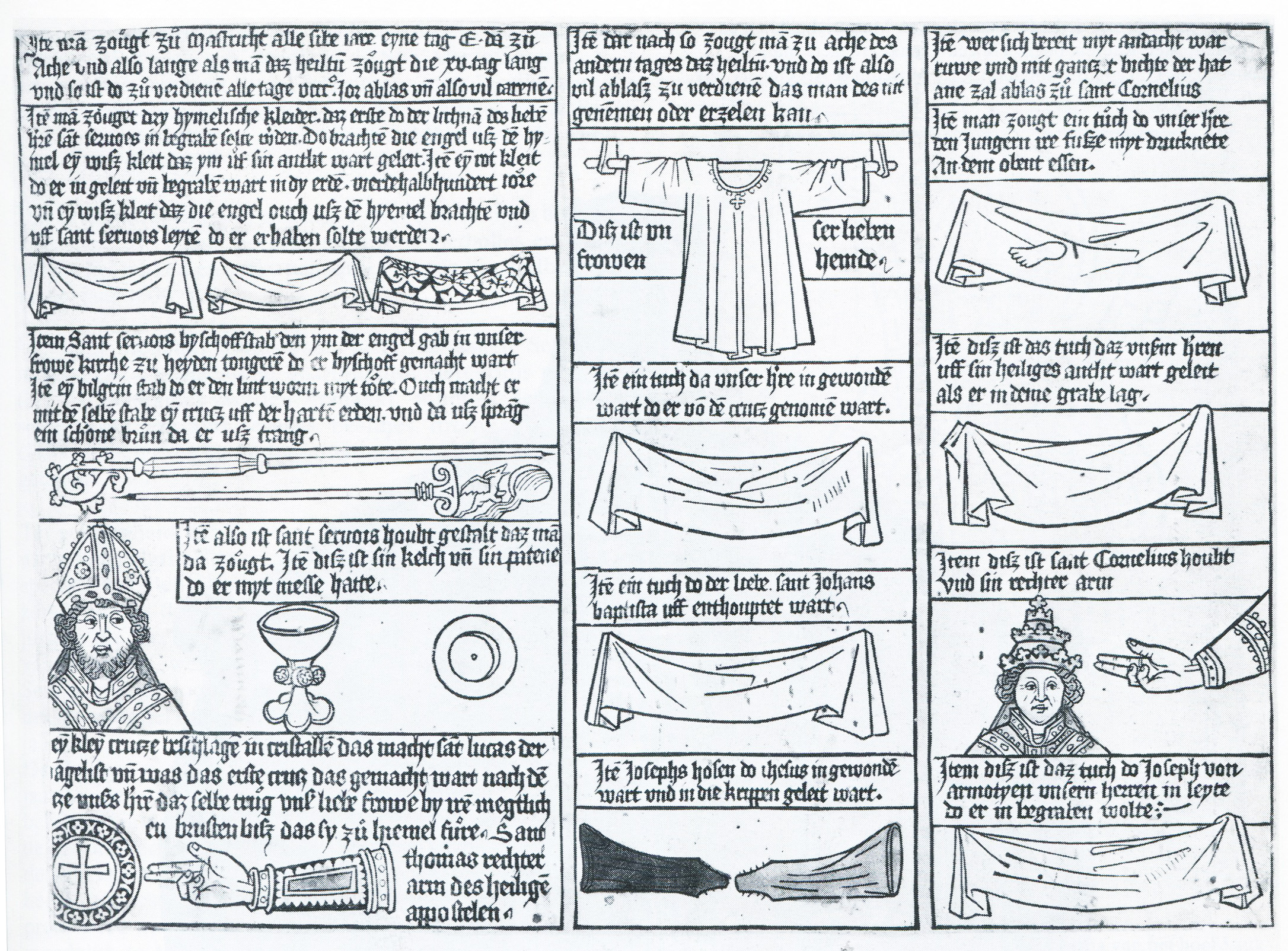
As a sort of advertisement or as a precursor of the Lonely Planet Guides loose leaves were printed which described the indulgences to be had and the relics to be seen. Often woodcuts of the relics were added to the text. We have a copy of such a leaf from Mainz (probably from 1468) giving the potential pilgrim information about the religious and the touristic gain to be had when he or she went to Maastricht and Aachen.

Brussels - KB - 837-45, fol. 134r: The ending of Text 69. The last two lines stand a little apart (by courtesy of the KBR Brussels)

Brussels – KB – 837-45, fol. 134r: The ending of Text 69. The last two lines stand a little apart (by courtesy of the KBR Brussels)

This leaf has a clear link with text 69 in the Geraardsbergen manuscript. The first part of that text contains the same textual information as is found on the leaf from Mainz (although the leaf is written in German and the text in the codex is written in Flemish). However, the text in the Geraardsbergen manuscript is longer. After the information about Maastricht and Aachen the famous relics that may be visited in Cologne are mentioned, and the text ends with a description of the way home: from Maastricht (with its new beautiful bridge) you have to go to Liège (with an even newer, and more impressive bridge), Huy, Namur and Marbais. The last leg of the trip, two lines of text, stands a little apart from the rest of the it: continue to Nijvel (near Brussels) and Edingen in order to finish your travels in Geraardsbergen (Grammont), in the ‘In the French shield’, a popular inn.

See also: the complete table of contents.

Return to: Story 1, Story 2 or Story 3

Further Reading: BNF, fr. 837

Editions of medieval works

Rutebeuf. Œuvres complètes, ed. by Michel Zink (Paris: Le Livre de Poche, Lettres gothiques, 2001)

Bibliography

Azzam, Waguih, ‘Un recueil dans le recueil. Rutebeuf dans le manuscrit BnF f. fr. 837’ in Mouvances et jointures: du manuscrit au texte médiéval, ed. by Milena Mikhaïlova (Orléans: Paradigme, 2005), pp. 193-201

Busby, Keith, Codex and Context: Reading Old French Verse Narrative in Manuscript, 2 vols (Amsterdam: Rudopi B. V., 2002)

Collet, Olivier, ‘“Encore pert il bien aus tés quels li pos fu” (Le Jeu d’Adam, v.11): le manuscrit BnF f. fr. 837 et le laboratoire poétique du XIIIe siècle’, in Mouvances et jointures: du manuscrit au texte médiéval, ed. by Milena Mikhaïlova (Orléans: Paradigme, 2005), pp. 173-92

— ‘Du “manuscrit de jongleur” au “recueil aristocratique”: réflexions sur les premières anthologies françaises’, Le Moyen Âge, 113 (2007), 481-99

Foehr-Janssens, Yasmina, ‘”Le seigneur et le prince de tous les contes”. Le Dit du Barisel et sa position initiale dans le manuscrit BnF f. fr. 837’, in Mouvances et jointures: du manuscrit au texte médiéval, ed. by Milena Mikhaïlova (Orléans: Paradigme, 2005), pp. 153-171

Krause, Kathy M., & Alison Stones (eds.), Gautier de Coinci: Miracles, Music, and Manuscripts (Turnhout: Brepols, 2006)

Rouse, Mary & Richard Rouse, Manuscripts and their Makers: Commercial Book Producers in Medieval Paris 1200-1500, 2 vols (Turnhout: Brepols, 1999)

Trachsler, Richard, ‘Observations sur les “recueils de fabliaux”’, in Le Recueil au Moyen Âge. Le Moyen Âge central, ed. by Olivier Collet & Yasmina Foehr-Janssens, Texte, Codex & Contexte VIII (Turnhout: Brepols, 2010), pp. 35-46

Useful links

Archives de littérature du Moyen Âge (ARLIMA)

http://gallica.bnf.fr

Hypercodex   (Research Project at the University of Geneva)

Rutebeuf: an author apart

In BNF fr. 837, one author in particular is given a starring role: the famous thirteenth-century poet Rutebeuf. Manuscript compilers rarely grouped together works according to authorship in the thirteenth century. Indeed, most shorter texts of this period are anonymous or unattributed.

Who was Rutebeuf?

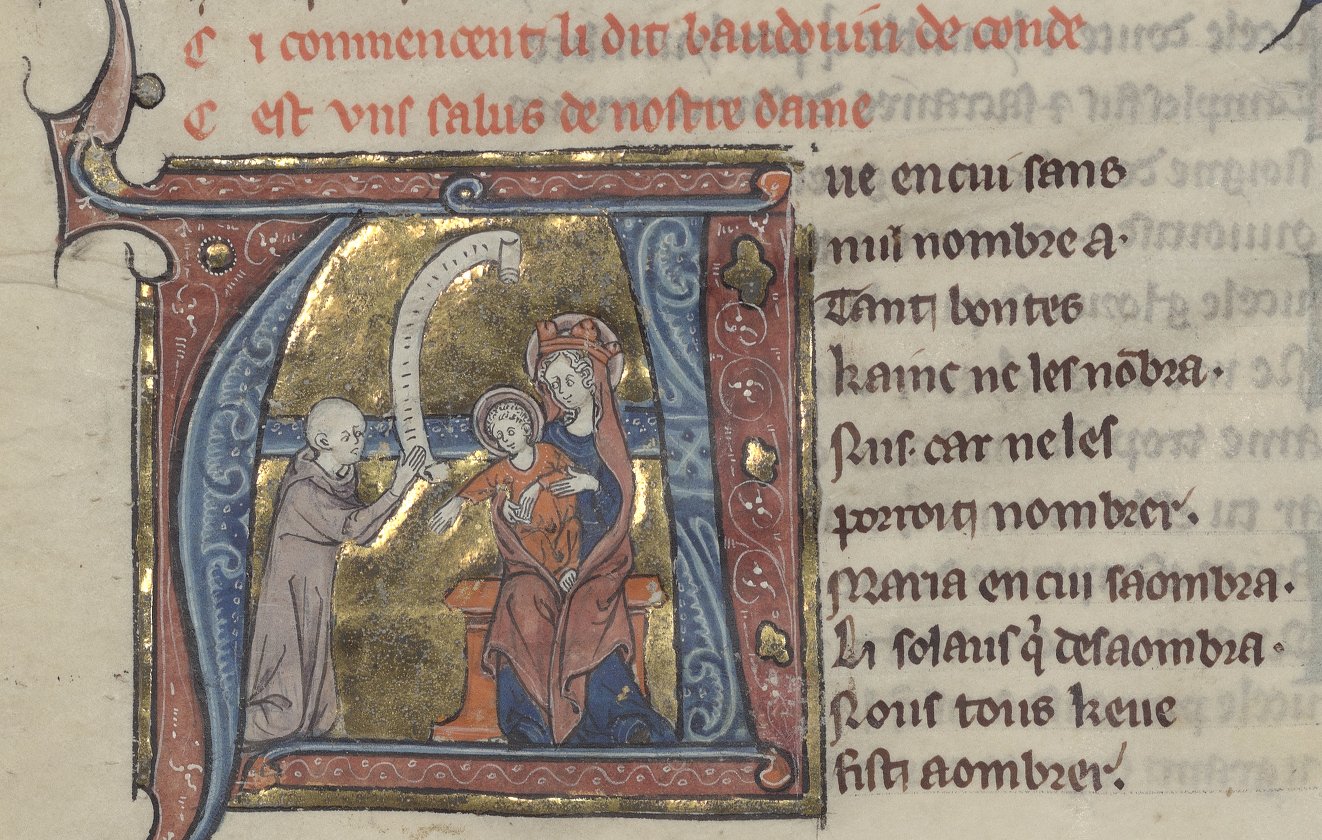
Rubric and image of Baudouin de Condé precedes his collection. Paris, Bibliothèque de l'Arsenal, MS 3142 f. 300v Reproduced by courtesy of Bibliothèque nationale de France : gallica.bnf.fr/?lang=EN

Rubric and image of Baudouin de Condé precede his collection of works.
Paris, Bibliothèque de l’Arsenal, MS 3142, f. 300v
Reproduced by courtesy of Bibliothèque nationale de France : gallica.bnf.fr/?lang=EN

Paris, Bibliothèque de l’Arsenal, MS 3142 is another contemporary codex which explicitly delineates an author’s collection of short works. This thirteenth-century French text collection includes a series of works by the poet Baudouin de Condé, introduced by a rubric (in red) marking his authorship and illustration. The image on the right shows the author Baudouin, dressed as a cleric, offering his works to the Virgin Mary and Christ child.


Genre in BNF, fr. 837

BNF, fr. 837 contains a wide range of texts; sacred and secular, edifying and rude, supernatural and mundane.

These include:
love poetry, prayers, paternosters, credos, abcs, funny stories, rude funny stories, tales of adventure, moral and edifying stories, astrology, texts about women, fables, love stories, saints’ lives, beast epic, tales of Heaven and Hell, texts about wine, historical notes, allegorical works, plays and dialogues, proverbs
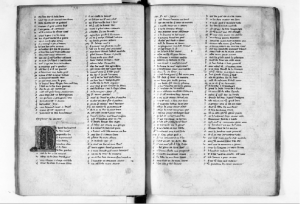
Paris, BNF, fr. 837 (pre 1300), ff. 66v-67r
Reproduced by courtesy of Bibliothèque nationale de France: http://gallica.bnf.fr/?

Here, a retelling of the Prodigal Son story (Cortois d’Arras) is juxtaposed with a fabliau, Boivins de Provins.

The last line of Cortois and the first line of Boivins are only a few lines apart. They are, respectively:

‘Chantons de deus laudamus’
(Let us sing about God; let us praise Him.)

and

‘Molt bons lechierres fu Boivins’
(Boivin was admirably fond of the pleasures of the flesh.)

This rather brings out the contrast between the two texts, but also suggests that medieval readers liked a variety of different types of reading matter.

In terms of moral viewpoint, the two texts are worlds apart. Cortois implicitly condemns both the sin of frolicking with prostitutes and the sin of pride, and believing oneself more entitled than others. What is important is forgiveness, even and especially of the unworthy.

Boivins, meanwhile, adopts a different stance. The main character carries out a complicated ruse in order to obtain free food, drink and sex, and is thought to be rather clever for doing so. It is patently amoral.

The form of the two texts is also different. Cortois is almost entirely dialogue, whereas Boivins is a story with a narrator.

However, there is an important similarity: in both cases, a sizeable proportion of the text is a scene at a brothel with two women attempting to swindle a man.

The main difference is that Cortois loses all his money to the women, whereas Boivin is tricking the women into thinking they are swindling him, while he swindles them. He is pretending to be what Cortois really is: an innocent, ready to be fleeced.

This really brings home how very interconnected medieval literature is, and makes us aware of the limits of genre labels: two texts, nominally belonging to different genres, may still have a lot in common.

Of course, many of the genre labelling words we use are largely the product of modern criticism. The word ‘fabliau’, for instance, did exist in medieval French, but it is used now to mean short stories in verse, mostly funny and sometimes rude: there is a (debated) canon of fabliaux, which includes many texts that do not call themselves fabliaux, and excludes some texts that do.

This particular manuscript does have a genre labelling system, but some  terms within that system seem more straightforward than others. The term ‘patrenostre’ is one which is clearer in meaning.
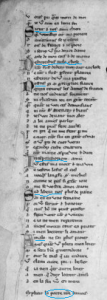
Edited paternoster
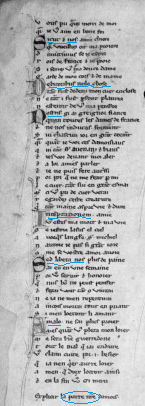
Paris, BNF, fr. 837 (pre 1300), f. 247v (detail).
Reproduced by courtesy of Bibliothèque nationale de France: http://gallica.bnf.fr/?

The manuscript contains several texts which are labelled as a ‘patrenostre’ in the explicit.
This is the end of a ‘patrenostre d’amours’, with the word ‘patrenostre’ in the explicit circled in blue.
The same format is used for all the ‘patrenostres’. The Latin text of the pater noster (Lord’s prayer) is broken up into small chunks, and used as a frame for the French verse text, which is sometimes a translation and expansion of the Latin, and sometimes utterly unrelated. The Latin framework is underlined in blue. As you can see, it forms a fairly small proportion of the text.


Here is another extract, transcribed and translated.

‘Sanctificetur…’
Paris, BNF, fr. 837 (pre 1300), f. 247r
Reproduced by courtesy of Bibliothèque nationale de France: http://gallica.bnf.fr/?

‘Sanctificetur. Douce dame
Qui es sauveresse de m’ame
Quant del cors me departira
Et li angeles l’emportera
Dame se deveniez m’amie
Molt en seroit mieudre ma vie
Nomen tuum. veraiement
m’est vis qu’ele est apertement
la plus bele…’

‘Hallowed be. Sweet lady
you who are the saviour of my soul
when it leaves my body
and the angel takes it away;
Lady, if you were to become my lover
my life would be much better.
Thy name. Truly,
I think that she is obviously
The most beautiful of all women…’

An ‘ABC’
Paris, BNF, fr. 837 (pre 1300), f. 170v (detail)
Reproduced by courtesy of Bibliothèque nationale de France: http://gallica.bnf.fr/?


Other similar genres are ABCs and Credos, which work in the same way, insofar as they have a framework (the alphabet or the Latin Credo) which is amplified with French verse.

For the terms fable, fabliau, dit, conte and ditié, things get rather more complicated.

Sometimes they seem interchangeable, but at other times they are used as if they have quite distinct meanings: even within this one manuscript.

Paris, BNF, fr. 837 (pre 1300), f. 199r (detail)
Reproduced by courtesy of Bibliothèque nationale de France: http://gallica.bnf.fr/?

Here, the words ‘conte’ and ‘dit’ appear to be used interchangeably: the word ‘conte’ is used within the text to refer to the text, but the explicit calls it a ‘dit’.


At other times, the impression is given that these words do have meanings, and mean different things. The beginning of this story, for example, sets up an opposition between ‘fable’ (made up stories) and truth.

Text opening with ‘fable’
Paris, BNF, fr. 837 (pre 1300), f. 265v (detail)
Reproduced by courtesy of Bibliothèque nationale de France: http://gallica.bnf.fr/?

‘Whoever makes rhymes or fables
Instead of telling you a fable
I will tell you an adventure that really happened:
Who it was about and how it ended.
I will tell you the truth about it.
It came to pass in a city
That there were two money-changers…’

Another text begins: ‘People make fabliaux out of fables, and new notes out of sounds…’


Next: Rutebeuf: an author apart


The first text: a matrix-text?

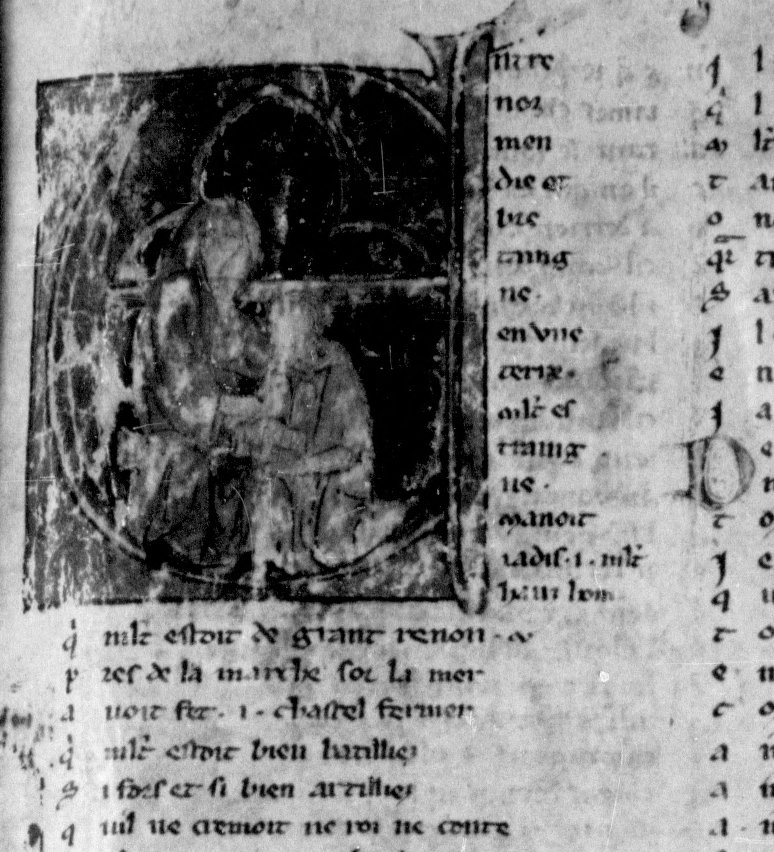
The first text of BNF fr. 837 has a more elaborately decorated initial than the other texts in the codex.

Paris, BNF, fr. 837, f. 1ra Reproduced by courtesy of Bibliothèque nationale de France: http://gallica.bnf.fr/?lang=EN

Paris, BNF, fr. 837, f. 1ra
Reproduced by courtesy of Bibliothèque nationale de France: http://gallica.bnf.fr/?lang=EN

It is not unusual in medieval manuscripts for the first initial to be bigger and more embellished than the rest. As we discuss here, the image in this historiated initial (?) could offer information about the codex’s original patron.

However, it also poses an interesting question of textual interpretation.

Does this mean that the first text is particularly important or significant? Should we consider it as having a higher status than the other texts in the manuscript?

Some critics, such as Yasmina Foehr-Janssens, have argued that the Dit du Barisel can be seen as a matrix text for the whole codex: all the other texts in the manuscript should be seen through the lens of this one text, and interpreted in its light. In other words, it becomes the key to understanding this diverse and wide-ranging codex, and represents a microcosm of the whole book.

The Dit du Barisel recounts the transformation of a unrepentant reprobate into a pious and humble man. There are many other stories in the codex that share the same themes of confession, repentance and the rehabilitation of sinners. Indeed, the first stories in the collection of works by Rutebeuf share these themes. Skip to our spotlight on Rutebeuf to find out more.

Like the Dit du Barisel, the majority of items in BNF, fr. 837 are relatively short. This has left scholars wondering if the codex was intended to be a manuscript of short texts. You can find out more about the question of length in BNF, fr. 837 by clicking here.