The Nine (mutilated) Worthies

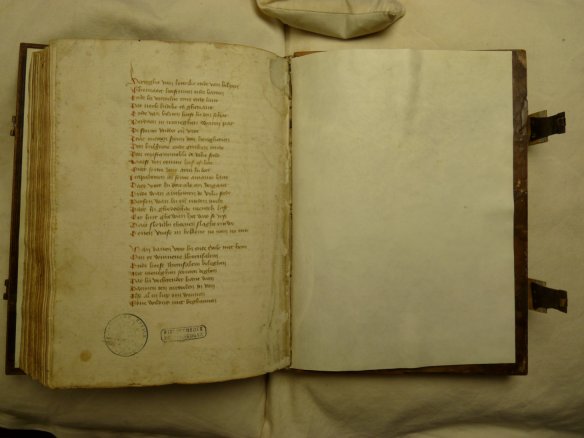
Brussels - KBR - 837-45, fol. 183v: The abrupt ending of The Nine Worthies (by courtesy of KBR Brussels)

Brussels – KBR – 837-45, fol. 183v: The abrupt ending of The Nine Worthies (by courtesy of KBR Brussels)

Geraardsbergen Manuscript, Text 89 (fols. 170v-183v)

By far the longest text in the Geraardsbergen manuscript is the well known verse text about the Nine Worthies: the nine most brave knights in history. The lifes and most remarkable deeds of three heathen knights (Hector of Troy, Alexander the Great and Julius Caesar), the Jewish knights (Joshua, David and Judas Machabeus) and three Christian knights (King Arthur, Charlemagne and Godfried of Bouillon) are described.

Compared to the other texts in this manuscript, the Nine Worhties seems the odd one out. It is longer and more narrative than most other texts. And there is one question that cannot be solved: was this really the last text in the manuscript? The text ends abruptly on the last leaf of the manuscript, leaving the reader in the dark about the end of Godfried of Boullion’s description and the epilogue. The scribe would have needed only a few more leaves. Did someone tear out the last bit, did it get damaged and therefore removed, or was the abrupt ending all the scribe did copy, or could copy? We will never know (but maybe…)

See also: the complete table of contents.

Go back to: Geraardsbergen Manuscript, Story 3

Taverns and Inns

Travellers, pilgrims and itinerary merchants all needed a place to sleep at night. They could stay at an inn, or sleep in a farmer’s barn, the former providing beer too! In the Geraardsbergen Manuscript we learn about an inn called ‘In the French shield’ in Geraardsbergen, once owned by Guillebert the Mets.

Inns and taverns were some of the most important social meeting places in the Middle Ages. The pilgrims in Chaucer’s Canterbury Tales, for instance,  meet in the ‘Tabard’ in Southwark before they set out on their pilgrimage.

For more information on inns and taverns, click here.

Go back to:


Guillebert de Mets

Guillebert de Mets was a scribe of manuscripts born in Geraardsbergen. Even though he is not mentioned in the Geraardsbergen Manuscript, there may have been a connection between him and this codex: Guillebert used to be the owner of an inn in Geraardsbergen mentioned in Text 69, the ‘In the French shield’.

Compared to the manuscripts Guillebert copied – books meant for the dukes of Burgundy, lavishly illuminated –  the Geraardsbergen Manuscript looks very modest.

It has been argued that Guillebert may have been involved in the production of the Geraardsbergen Manuscript (see Story 2), but that seems unlikely. The presence of Dutch, French and Latin texts seems to fit his profile, but since there are no archival records about him anymore after 1460 the chances he copied this manuscript in the 1460’s are small. This does not rule him out as a possible compiler, though.

Pieteren den Brant

In the early fourteenth century in the city of Geraardsbergen a relatively well-organized group of actors was active. This group was allowed by the town council to do performances during the most important events each year. In the 1420 the group became more prominent when they switched from religious plays to more profane pieces, e.g. the Chanson de Rolande. An act from 1427 shows that this group of actors was directed by Pieteren den Brant, apparently a woodcraftsman by profession, but somehow able to spend much time on stage.

Pieteren den Brant is one of the few authors in the Geraardsbergen Manuscript referred to by name. The text mentioning his name in the opening rubrics is Text 83. It counts 100 lines and gives descriptions of the four temperaments of man: phlegmatic, choleric, sanguine and melancholic. The ideas underlying the text are based on common knowledge of astrology and humorism. The information the reader receives in this text is altogether not very difficult to understand for an average, medieval, urban audience. Pieteren does not seem to know every detail of this theory either. The text becomes even more a ‘humorism for dummies’ by the insertion of stopgaps (e.g. ‘verstaet na mi’ – ‘believe me’).

Return to:

The Gruuthuse Manuscript

The Gruuthuse Manuscript (see online version) is a unique codex that still carries many secrets. It consists of prayers, poems and a remarkable collection of nearly 150 songs. Many of the songs are profane songs, mostly about love, complete with musical notation. This songbook is the largest and oldest collection of this genre from the medieval Low Countries.

The Gruuthuse manuscript is on exhibition until 23 June 2013

The Gruuthuse Manuscript is on display until 23 June 2013

In some of the songs, the city of Bruges is mentioned, and several of the writers are also associated with Bruges. But even though some names can be found in acrostics in the songs (e.g. Jan van Hulst), many questions about the manuscript remain unanswered. It is still unknown who ordered to write the manuscript, and for what reasons he did so. Furthermore, it is unclear who compiled the manuscript or who wrote the texts.

Visiting Bruges this Spring? This manuscript is on display until 23 June 2013 in the Gruuthuse Museum!

Back to: Jan van Hulst

Jan van Hulst

Jan van Hulst was a writer from Bruges who wrote some texts that ended up in both the Gruuthuse manuscript and in the Geraardsbergen manuscript. In the Gruuthuse manuscript, we find his name in an acrostic in two prayers and a poem, but there are some other texts that may be attributed to him as well. And he may have been the founder of the first chamber of rhetoric in Bruges.

Jan is frequently mentioned in archival documents from Bruges. He was, for example, commissioned to organise a play at Philip the Bold’s visit to the city of Bruges in 1393. And he is known to have organized polyphonic performances in churches.

The text in the Geraardsbergen manuscript is a letter to his friend, the priest and singer Perceval vanden Nocquerstocque. It was a rhymed letter about the loss of loyalty among friends.

Back to: People connected with the Geraardsbergen Manuscript

Perceval vanden Nocquerstocque

One of the most striking names in the Geraardsbergen manuscript is the name of Perceval vanden Nocquerstocque, member of a patrician family. Perceval was a priest in Geraardsbergen and was befriended with Jan van Hulst, who wrote him a rhymed letter about the loss of loyalty among friends. Jan and Perceval probably met through their shared interest in polyphonic music. Jan organized polyphonic performances in churches in Bruges while Perceval had a second career as a singer in polyphonic choirs.

In 1417 Perceval, probably in his late fourties, is mentioned as one of the singers in the Papal Chapel during the Council of Konstanz. As a member of the household of Pope Martinus V, he travelled to Switzerland after the Council had ended. In 1418 the pope resided in Geneva, but had to flee to the mountains when the city was afflicted by the plague. The pope survived, but Perceval was never heard of again.

For more information: see Further reading (Herman Brinkman’s article)

Back to: People connected with the Geraardsbergen Manuscript

Further reading: Geraardsbergen Manuscript

For more information on the Geraardsbergen Manuscript, you can consult the following publications:

Herman Brinkman, ‘Weerzien met Geraardsbergen’. In: Literatuur 21 (2004), pp. 11-13.

Theo Coun, ‘Codicologie of archeologisch graafwerk in middeleeuwse boeken’. In: Ria Jansen-Sieben, Jozef Janssens en Frank Willaert (eds.), Medioneerlandistiek. Een inleiding tot de Middelnederlandse letterkunde. Hilversum: Verloren, 2000. pp. 71-84. Middeleeuwse studies en bronnen, 69.

Marie-José Govers et al. (ed.), Het Geraardsbergse handschrift. Hs. Brussel, Koninklijke bibliotheek Albert I, 837-845. Hilversum: Verloren, 1994. Middeleeuwse Verzamelhandschriften uit de Nederlanden, 1. (electronic version of this edition, by Peter Boot and Herman Brinkman).

Marie-José Govers, ‘Van Ptolemaeus tot Joris. Een verkenning van een reeks bijschriften in het Geraardsbergse handschrift.’ In: G. Sonnemans, Middeleeuwse verzamelhandschriften uit de Nederlanden : congres Nijmegen, 14 oktober 1994. Hilversum: Verloren, 1996. pp. 125-143. Middeleeuwse studies en bronnen, 51.

Hans Kienhorst, ‘Hoe moet zo ‘n boek genoemd worden? Een vernieuwde kijk op Middelnederlandse verzamelhandschriften als codicologisch object’. In: Revue Belge de philologie et d’histoire 83 (2005), pp. 785-817 (for the Geraardsbergen manuscript, see pp. 790-792).

Robrecht Lievens, ‘Het Geraardsbergse handschrift.’ In: Leuvense bijdragen 85 (1996), pp. 147-161

Joris Reynaert, ‘De verborgen zijde van de middeleeuwse kopiist. Over de functie en de samenstelling van het Geraardsbergse handschrift’. In: Queeste 6 (1999), pp. 41-52.

Hubert Slings, ‘De Negen Besten ontcijferd. Getallensymboliek in het Geraardsbergse afschrift van Van den Negen Besten’. In: Queeste 3 (1996), pp. 25-42.

Gerard Sonnemans, ‘What’s in an name? Het belang van opschriften in verzamelhandschriften.’ In: G. Sonnemans, Middeleeuwse verzamelhandschriften uit de Nederlanden : congres Nijmegen, 14 oktober 1994. Hilversum: Verloren, 1996. pp. 61-78. Middeleeuwse studies en bronnen, 51.

Gerard Sonnemans, ‘Profiel van een Geraardsbergs compilator.’ In: G. Sonnemans, Middeleeuwse verzamelhandschriften uit de Nederlanden : congres Nijmegen, 14 oktober 1994. Hilversum: Verloren, 1996. pp. 110-124. Middeleeuwse studies en bronnen, 51.


Geraardsbergen, a Flemish town

In the 1060s, Geraardsbergen (Grammont) was founded as a strategic stronghold on the eastern border of the county of Flanders. With the economic attractive center at the western part of his county (with cities such as Ghent and Bruges), it was important for the count to attract people to the financially backwards eastern part of his reign. A way to do so was to promise the people in – or willing to move to – the East relative independence by assigning cities such as Geraardsbergen municipal laws. This strategy worked: the cities and their importance grew, as becomes clear (for example) from references to Geraardsbergen as a centre of (cloth) trade and production in the twelfth century.

The story of Geraardsbergen is certainly not all good news, as it has been a place of troubles several times. In the 1430s, for example, it was one of the centers of a peoples’ revolt against financial arrangements of the authorities. A century later, once again the people of Geraardsbergen revolted against the city rulers, this because the latter (in the opinion of the former) had chosen sides with the central authorities in a tax dispute.

Nowadays, the city of Geraardsbergen is known for a completely different kind of battle. Each Spring, thousands of cycling pro’s and tourists travel to Flanders to participate in the annual Tour of Flanders. The ‘high mass’ of the early cycling season is one of the oldest and most renown races on the cycling calendar. Perhaps the single most famous and certainly one of the most feared hills on the Northern side of the Alps is situated in Geraardsbergen: the Muur van Geraardsbergen (‘Wall of Geraardsbergen’), a steep climb onto the city’s ramparts.

Go to: Geraardsbergen manuscript

A Pilgrim as a Tourist

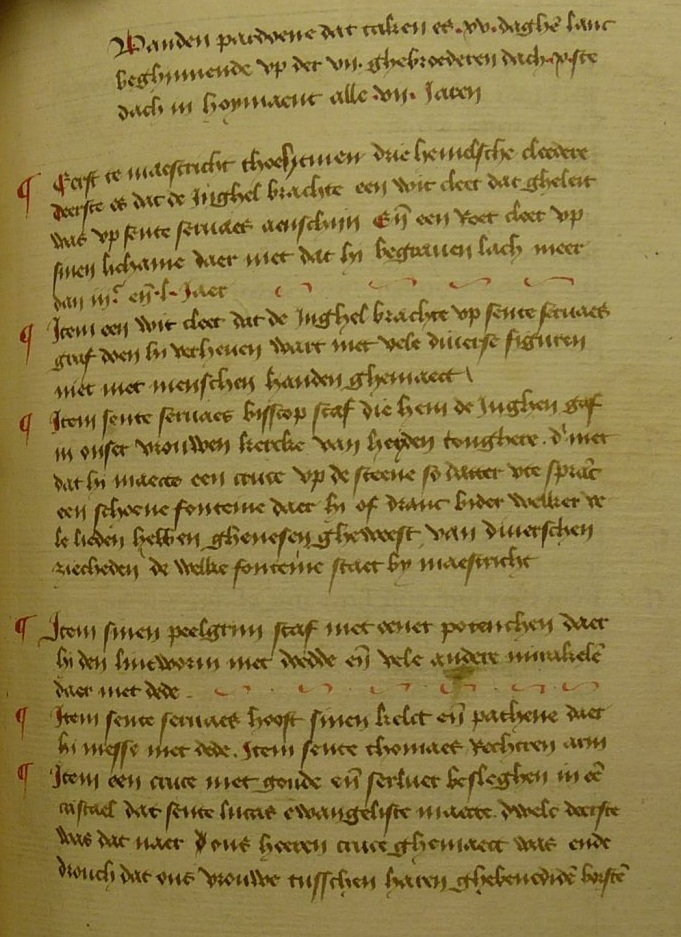
Brussels - KB - 837-45, fol. 133r: The ending of Text 69. The last two lines stand a little apart (by courtesy of the KBR Brussels)

Brussels – KB – 837-45, fol. 133r: The beginning of Text 69 (by courtesy of the KBR Brussels)

Geraardsbergen Manuscript, text 69 (fols. 133r-134r)

During the middle ages the main reason for going on a pilgrimage was that is was a positive element in bringing you salvation. There were places where you could always go (the most famous ones being Rome and Santiago de Compostella) but many other places had special religious festivities for a saint or a sanctuary too. Examples of this may be found in Maastricht and Aachen (Aix-la-Chapelle). In both places there was a special religious festival every seven years during which some relics were exhibited for the pilgrims that were normally kept behind closed doors. Visiting these relics was seen as an especially good deed. In both Aachen and Maastricht, the years in which these special pilgrimages took place were the same, and in those years there was also a special religious ‘exhibition’ in the monastery of Cornelimünster, near Aachen. So when you went in the correct year to this region you could deserve many indulgences in a day or two (up to 800 years less in purgatory!). And as a bonus you could see some very interesting relics that were normally not on display.

Der gude Sente Servas

Der gude Sente Servas

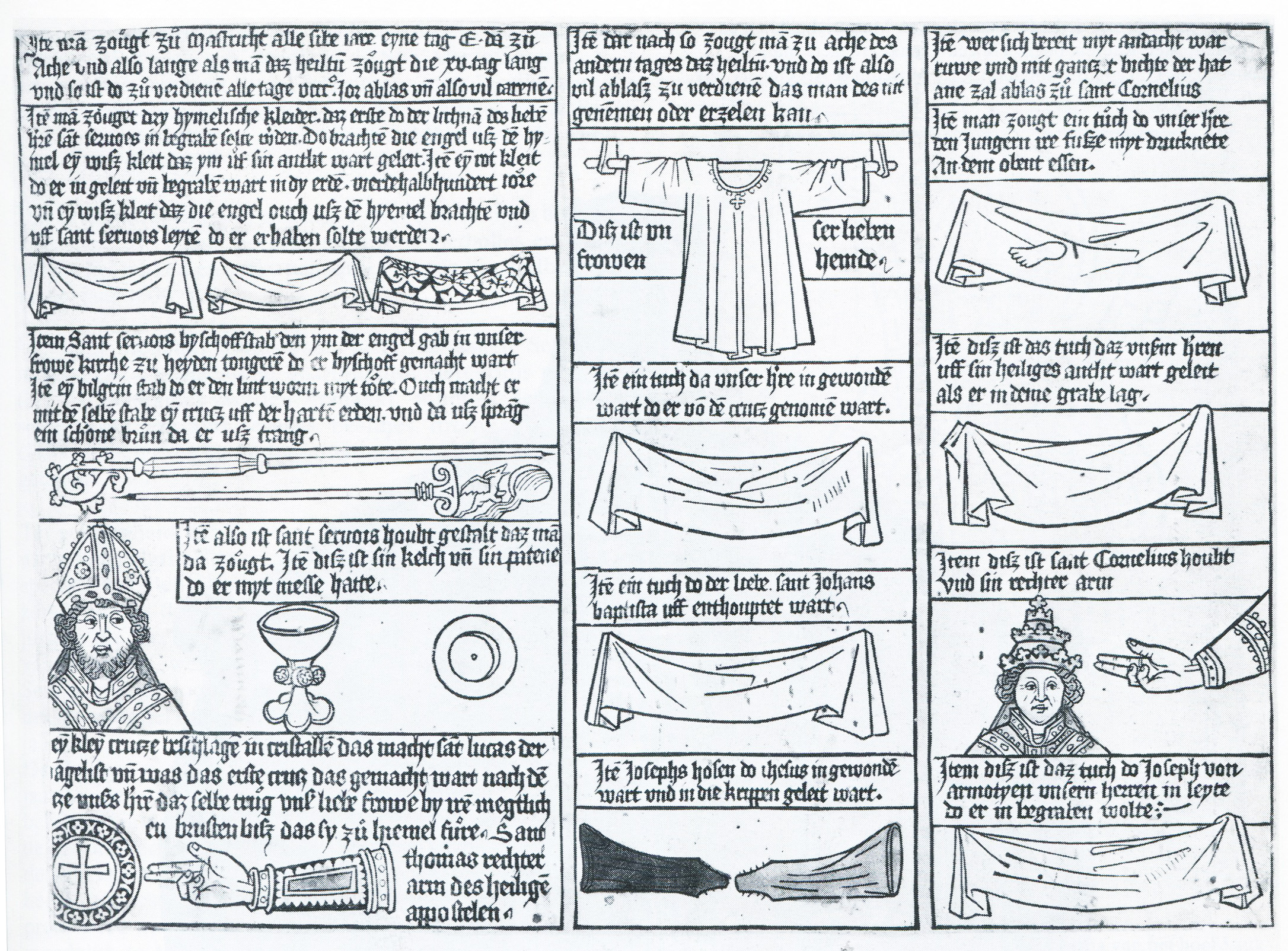
As a sort of advertisement or as a precursor of the Lonely Planet Guides loose leaves were printed which described the indulgences to be had and the relics to be seen. Often woodcuts of the relics were added to the text. We have a copy of such a leaf from Mainz (probably from 1468) giving the potential pilgrim information about the religious and the touristic gain to be had when he or she went to Maastricht and Aachen.

Brussels - KB - 837-45, fol. 134r: The ending of Text 69. The last two lines stand a little apart (by courtesy of the KBR Brussels)

Brussels – KB – 837-45, fol. 134r: The ending of Text 69. The last two lines stand a little apart (by courtesy of the KBR Brussels)

This leaf has a clear link with text 69 in the Geraardsbergen manuscript. The first part of that text contains the same textual information as is found on the leaf from Mainz (although the leaf is written in German and the text in the codex is written in Flemish). However, the text in the Geraardsbergen manuscript is longer. After the information about Maastricht and Aachen the famous relics that may be visited in Cologne are mentioned, and the text ends with a description of the way home: from Maastricht (with its new beautiful bridge) you have to go to Liège (with an even newer, and more impressive bridge), Huy, Namur and Marbais. The last leg of the trip, two lines of text, stands a little apart from the rest of the it: continue to Nijvel (near Brussels) and Edingen in order to finish your travels in Geraardsbergen (Grammont), in the ‘In the French shield’, a popular inn.

See also: the complete table of contents.

Return to: Story 1, Story 2 or Story 3