A Manuscript of Short Texts?

Paris, BNF, fr. 837 (pre 1300), ff. 252v-253r
Reproduced by courtesy of Bibliothèque nationale de France: http://gallica.bnf.fr/?lang=EN

BNF, fr. 837 is mostly composed of short texts. Some of the shortest are lyric poems and texts denouncing bad behaviour; the longest is a saint’s life, and other long ones include a long lyric poem and a short story.

Although the longer texts are much longer than the shorter ones, the manuscript contains no extremely long texts; many other manuscripts have much greater variation in text length.

However, there are some places in the manuscript where several pages are missing, and for many of these, it is possible that some of the missing texts were long texts. Keith Busby suggests that the long texts were removed quite deliberately, to turn the manuscript into a collection of short texts, when perhaps it started off as a collection of texts of varying lengths.
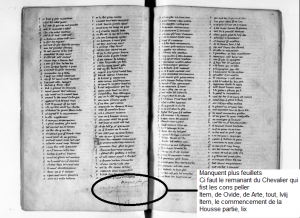
Paris, BNF, fr. 837 (pre 1300), ff. 149v-150r
Reproduced by courtesy of Bibliothèque nationale de France: http://gallica.bnf.fr/?

This is one of those places. As well as a nineteenth-century note that there are some pages missing, there is also a note of missing texts in a fourteenth-century hand. Either this person had access to a table of contents for the manuscript, or he had access to another copy, and he felt it was a good idea to make notes of all the missing texts.

He notes that the rest of the text on the first page,  ‘Le Chevalier qui fist parler les cons’ is missing, and that the beginning of the text on the second page, ‘La Housse partie’, is also missing. He also notes one missing text between them: a version of Ovid’s Art of Love.

There were many different versions of Ovid’s Art of Love circulating in medieval French; four have survived, and we know of at least one, by Chrétien de Troyes, that hasn’t. They varied enormously in length.

It is possible that the missing Ovid had the full Latin text, and a French translation. That would make it a very long text indeed, and would fit Busby’s theory that somebody deliberately removed the very long texts.

On the other hand, some versions of the Art of Love were considerably shorter. There is a version that survives in another manuscript BNF, fr. 19152 which has a very similar medieval title, ‘Ci comence de Ovide de Arte’, and which is relatively short: the same length as the ‘Le Vair palefroi’, the third longest text in our manuscript. If the missing Art of Love were that version, it would not seem out of place at all.

We cannot know for certain. That is one of the fascinating (and sometimes frustrating) things about medieval studies – sometimes the answer is not recoverable.

Next: Reader intervention

The Golden Age

The period from 1275 until 1325 could easily be described as the golden age for the production of large literary manuscript collections in Northern France. For more information on the diverse compilations from this period see the work of the Hypercodex team.

BNF, fr. 837 was probably created around the last quarter of the thirteenth century and offers one example of the manuscript compilations produced in this vibrant period.

The codicological evidence suggests that BNF, fr. 837 was produced in a professional setting rather than by an amateur compiler. The style of decoration and illustration often provides the most important evidence for identifying the geographical and historical origins of a codex. The style of decoration found in BNF, fr. 837 links the manuscript to Paris. Alison Stones has  suggested that it may be associated with the artist known as the Hospitaller Master, who is known to have worked in the region of Paris until around 1280. For more information about the decoration of manuscripts click here.

Paris emerged as an important centre of commercial book production in the later Middle Ages. Richard and Mary Rouse examine the processes and people behind book trade in their seminal study, Manuscripts and their Makers. See further reading for more information.

To discover more about the manufacture of this codex click here.


A Veritable Cornucopia

Paris, Bibliothèque nationale de France, fonds français 837

Paris, BNF, fr. 837 is a large manuscript collection which contains an incredible array of medieval French texts. It constitutes one of the most important witnesses of thirteenth-century vernacular (?) literature produced in northern France. Moreover, the manuscript also bears witness to what might be described as a boom in the production of large literary multi-text codices. Find out more here.

At first sight, it seems to be a highly disparate miscellany. Indeed, the generic diversity of this codex has left many critics bedazzled. Learn more about the the codex’s complex cocktail of genres.

However, is it possible to identify any principles of organisation that govern its arrangement? And can the first text provide any significant clues?

The beginning of Rutebeuf's author collection in BNF, fr. 837, f. 283vb Reproduced by courtesy of Bibliothèque nationale de France: http://gallica.bnf.fr/?lang=EN

The beginning of Rutebeuf’s author collection in BNF, fr. 837, f. 283vb
Reproduced by courtesy of Bibliothèque nationale de France: http://gallica.bnf.fr/?lang=EN

In its current condition all of the texts are exceptionally short in length. Why is this? Did length play a role in the various stages of its organisation?

At a time when most short texts were transmitted anonymously, what is the significance of an author collection in this codex?

The codex appears to have passed through the hands of various readers, with quite different concerns. Interested in finding out more about their scribblings? Click here.